
Research
We conduct applied and theoretical research on Icelandic language, literature, history and culture.
The Institute employs a number of permanent scholars, and provides visiting scholars with research facilities for periods of varying length.
In addition, several doctoral students and postdoctoral researchers have research facilities at the Institute, enabling them to work on their projects in close collaboration with both staff and visitors.
The Snorri Sturluson Icelandic Fellowships, administered by the Árni Magnússon Institute, are awarded to writers, translators and scholars (not to university students) from outside Iceland to enable them to pursue their research in Iceland.
In addition, the Institute arranges seminars and conferences in its areas of scholarly endeavour.
The Institute employs a number of permanent scholars, and provides visiting scholars with research facilities for periods of varying length.
In addition, several doctoral students and postdoctoral researchers have research facilities at the Institute, enabling them to work on their projects in close collaboration with both staff and visitors.
The Snorri Sturluson Icelandic Fellowships, administered by the Árni Magnússon Institute, are awarded to writers, translators and scholars (not to university students) from outside Iceland to enable them to pursue their research in Iceland.
In addition, the Institute arranges seminars and conferences in its areas of scholarly endeavour.
Publications
The Árni Magnússon Institute for Icelandic Studies publishes various scholarly works, including two journals.
In addition, it publishes manuscript editions, folkloric material, dictionaries and other handbooks on the Icelandic language, and name catalogues.
It also publishes a newsletter, conference proceedings, and various other shorter informational works.
In addition, it publishes manuscript editions, folkloric material, dictionaries and other handbooks on the Icelandic language, and name catalogues.
It also publishes a newsletter, conference proceedings, and various other shorter informational works.
Journals
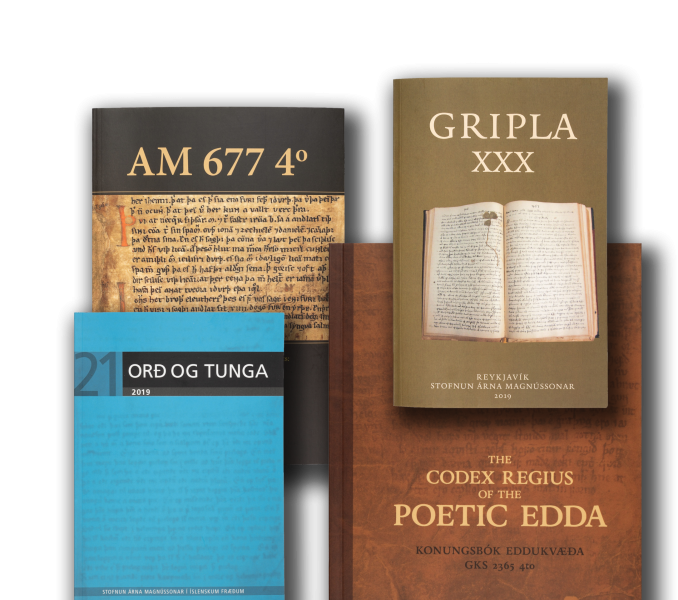
Gripla
Gripla is a peer-reviewed journal published in December each year.
Orð og tunga
Orð og tunga is a peer-reviewed journal published each year.
Online dictionaries
Books and other publications
Explore the catalog of our publications
Most of the material is in Icelandic, but we also publish books and articles in English and other languages.
Recent highlights of published works in English
Recent book in English: Agnesarkver. Saint Agnes of Rome in Post-Medieval Icelandic Verse
The book focuses on St. Agnes, who is believed to have died at the age of only 13 during the persecution of Christians in Rome around 303-304. She is said to have refused to marry the pagan son of a high-ranking official and held fast to her faith and convictions despite threats and abuse.
In Agnesarkver there is a comprehensive overview of sources about Agnes as well as her saga, in addition to the text of the four poems which appear alongside an introduction and academic discussion.
In Agnesarkver there is a comprehensive overview of sources about Agnes as well as her saga, in addition to the text of the four poems which appear alongside an introduction and academic discussion.
Recent book in English: Structural Alteration of Manuscripts in the Arnamagnæan Collection
The Arnamagnæan Collection, now jointly housed in Reykjavík and Copenhagen, is one of the most important collections of Old Norse and Icelandic manuscripts.
Structural Alteration reveals that both paper and parchment codices in this collection underwent physical restructuring at the hands of the collector, Árni Magnússon (1663–1730). The study examines the nature of these structural changes, the methods involved, and the motivations behind them.
Structural Alteration reveals that both paper and parchment codices in this collection underwent physical restructuring at the hands of the collector, Árni Magnússon (1663–1730). The study examines the nature of these structural changes, the methods involved, and the motivations behind them.
The Rímur Poetry of Ten Kvæðamenn: Research on Variations
An academic work in open access.
The book examines the performance of ten rímur singers. It describes how Svend Nielsen and Hallfreður Örn Eiríksson searched for individuals who had learned how to sing rímur, and had sung them for others, at a young age, and were still able to perform some of their early repertoire. The main aim of the collecting, which took place 1964–71, was to discover whether it was possible to find examples of rímur melodies of the sort Bjarni Þorsteinsson described in his Íslenzk þjóðlög (1906–9).
The book examines the performance of ten rímur singers. It describes how Svend Nielsen and Hallfreður Örn Eiríksson searched for individuals who had learned how to sing rímur, and had sung them for others, at a young age, and were still able to perform some of their early repertoire. The main aim of the collecting, which took place 1964–71, was to discover whether it was possible to find examples of rímur melodies of the sort Bjarni Þorsteinsson described in his Íslenzk þjóðlög (1906–9).