

This summer marks forty years since the first International Summer School in Icelandic Language and Culture was held at the University of Iceland in 1986. The course was specially made for students from universities abroad who came to Iceland for four weeks of intensive study to improve their knowledge of the Icelandic language and learn more about the culture, history, literature, society and nature.
It is worth noting that Nordkurs summer courses for Nordic university students had already been held every other year at the University of Iceland since the 1950s. The establishment of the International Summer School laid the foundation for the teaching and study of Icelandic language and culture among students from all over the world. Since 1989, both these summer courses have been held annually at the University of Iceland, initially in cooperation with the Sigurður Nordal Institute and later with the Árni Magnússon Institute for Icelandic Studies.
From the very beginning, interest among international students has been high, and there have always been more applicants than available places. Around one hundred students apply to take part in the Summer Course each year, but because of limitations on classroom capacity, only approximately forty can be admitted. This year, a record 150 applications were received, but only 46 applicants were accepted due to space constrains.
Students are divided into two groups according to their level of proficiency. After the introduction of the Icelandic Online web-based course in 2004, all applicants have been required to complete the first part of the online course before beginning their summer studies. This allows students to become familiar with the basics of Icelandic and therefore to prepare well for the programme. Most participants come from English- and German-speaking countries, although students from other parts of Europe, the Americas, Asia, Australia, the Middle East and Africa often participate in the programme.
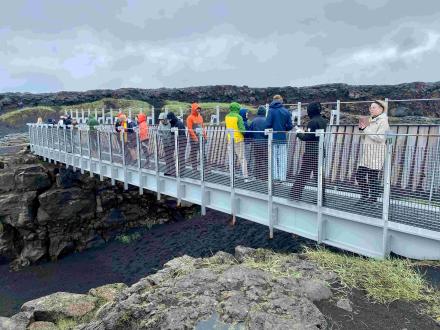
Today, the International Summer Course takes place over four weeks in July and provides seventy hours of intensive Icelandic-language instruction. In addition, ten guest lectures are offered on Icelandic culture, history, literature, society and nature. Students are introduced to the cultural life of Reykjavík, take part in educational excursions to historical sites and visit some of the country’s most important natural attractions.
During the COVID-19 pandemic, an online course was offered to students who were unable to travel. Since then, an online course has regularly been offered in parallel to in-person classes. All participants are registered as summer students at the University of Iceland, enabling them to receive formal confirmation of the credits awarded after completing their examinations.
Many former participants have become dedicated friends of Iceland and have, among other things, worked for Icelandic companies and various other organisations internationally. Some continue their studies in Icelandic, Icelandic literature or translation studies, either at the University of Iceland or at their home universities, where similar programmes are available.
To mark the anniversary, further projects and activities are being planned as part of the International Summer School’s programme celebrated this year. These include podcast episodes about the Summer School, which have been published on the Institute’s website, conference, and others. The Summer School’s coordinator can provide further information about the forthcoming activities at branislav.bedi@arnastofnun.is.